

Imagine facing a crisis when every second counts, but you cannot understand the warnings or...
In 2026, the world is more connected than ever, but language barriers still stand in the way of true global communication. Every day, individuals and organizations encounter challenges that can only be solved if they can translate english to any language with precision and speed.
This expert guide is designed to empower you with proven methods, the latest tools, and actionable steps for seamless translation. Whether you are working on a personal project, leading a business, or managing mission-critical communications, mastering translation is crucial.
Inside, you will discover how translation technology has evolved, the step-by-step process to achieve accurate results, and the best practices for advanced tools, human and AI collaboration, and future trends. Let this guide be your roadmap to overcoming language barriers and achieving effortless multilingual communication.
The Evolution of Language Translation: 2026 Landscape
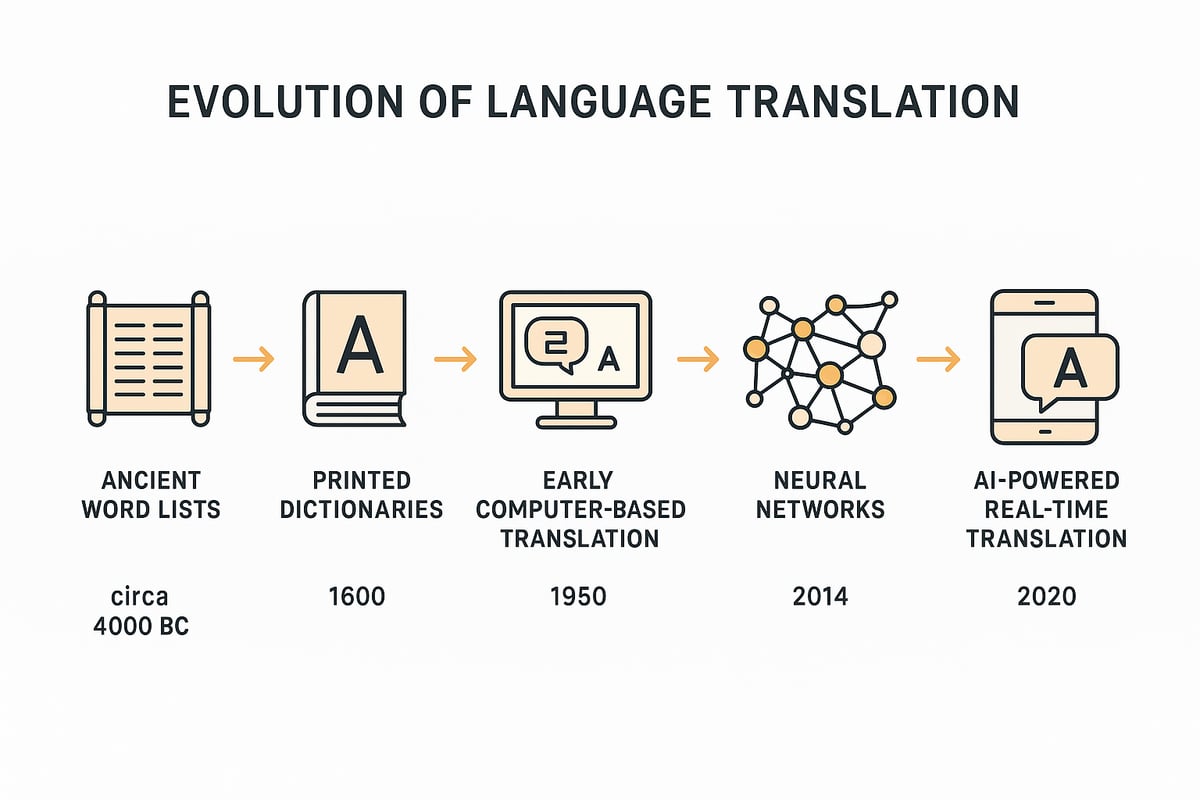
Language translation has undergone a remarkable transformation, allowing people to translate english to any language with increasing ease and accuracy. Early methods relied on simple word lists, basic dictionaries, and phrasebooks. These resources required manual effort and often lacked the nuance needed for effective communication.
As societies globalized, the need to translate english to any language grew across business, diplomacy, and everyday life. The 20th century saw the rise of rule-based and statistical machine translation, laying the groundwork for today's advanced systems.
Key Milestones in Translation Technology
The journey to seamlessly translate english to any language has been marked by several pivotal milestones:
| Year | Innovation | Impact |
|---|---|---|
| 1954 | First machine translation demo | Proved computers could process languages |
| 1990s | Statistical machine translation | Improved accuracy using big data |
| 2016 | Neural machine translation (NMT) | Enabled contextual, fluent translations |
| 2021 | Real-time speech-to-text | Broadened accessibility for spoken language |
| 2025 | Context-aware AI engines | Handled idioms, dialects, technical jargon |
By 2026, more than 7,000 languages are spoken worldwide, yet 80% of all digital content is available in only 10 major languages. This disparity highlights the ongoing challenge to translate english to any language, especially for minority or endangered tongues.
Recent Breakthroughs and Integration
Modern AI models now translate english to any language with over 95% accuracy for popular language pairs. They have learned to manage idiomatic expressions, regional dialects, and specialized terminology. Deep learning and vast datasets enable these systems to capture context and nuance, reducing errors that previously hindered communication.
Translation is now embedded in daily life. Smart devices instantly translate english to any language for users on the go. Business platforms offer multilingual support in real time. Emergency services, such as 911 centers, use AI-driven tools to help non-English speakers in critical situations.
Real-World Examples
Recent updates, like Google Translate’s 2025 launch of seamless video translation, have made it possible to translate english to any language directly from live video streams. Microsoft’s AI interpreter for live events supports dozens of languages simultaneously, breaking down barriers at global conferences.
These advances have redefined expectations for speed and accuracy. The ability to translate english to any language in real time is no longer a futuristic vision, but an everyday reality.
Current Challenges
Despite these achievements, several challenges remain:
- Limited support for minority and endangered languages
- Capturing cultural nuance and local context
- Ensuring data privacy and security during translation
Efforts to translate english to any language must address these gaps to achieve true global inclusivity. For further insights into overcoming these challenges and exploring practical solutions, see the English to Different Languages Translation Guide.
The evolution of translation technology has set the stage for a world where everyone can translate english to any language, but continuous innovation and ethical consideration are essential to reach every voice.
Step-by-Step Guide: How to Translate English to Any Language
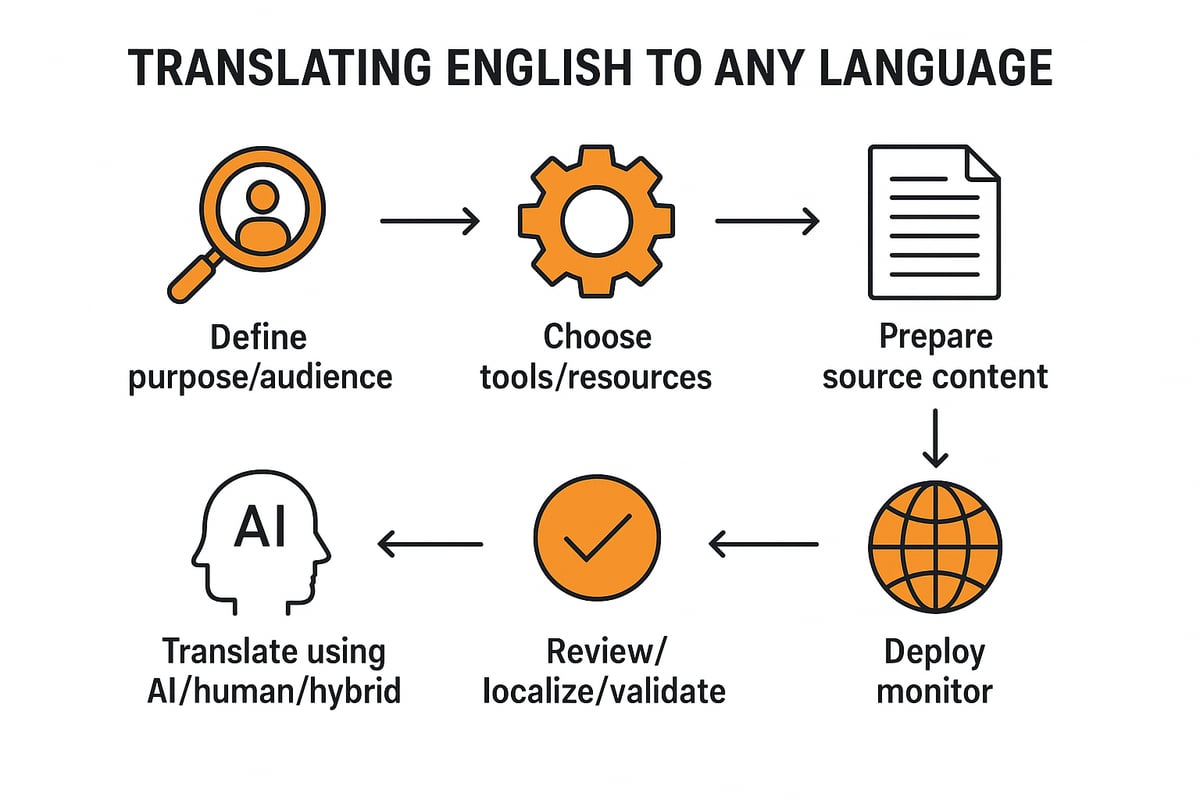
Breaking language barriers in today’s connected world is both a science and an art. Whether you are a business leader, a student, or a first responder, learning how to translate english to any language with accuracy and speed is essential. This step-by-step guide offers a practical roadmap, from defining your translation needs to deploying content in multiple languages.
Step 1: Define Your Translation Purpose and Audience
The first step to translate english to any language is to clarify your end goal. Are you translating for casual conversation, business communication, academic research, or emergency response? Each context demands a different level of accuracy and tone.
Understanding your audience is crucial. Consider age, cultural background, literacy level, and familiarity with the subject. For example, medical instructions require absolute clarity and technical precision, while marketing slogans need to resonate emotionally and culturally.
According to CSA Research (2024), 72% of consumers prefer information in their native language. This shows why it’s vital to adapt tone and terminology for each demographic. Always account for regional dialects or idiomatic expressions. Overlooking these can lead to confusion or even offense.
- Example: A phrase that works in British English may not resonate with American or Australian audiences.
- Pitfall: Literal translations of idioms can result in awkward or meaningless phrases.
By investing time in this stage, you set the foundation to translate english to any language accurately and contextually.
Step 2: Choose the Right Translation Tools and Resources
Selecting the right tools is essential to translate english to any language efficiently. Today’s landscape offers a spectrum of translation options, from free platforms to enterprise-grade solutions, and from AI-powered engines to professional human translators.
Key criteria for selection include:
- Language pair support
- Subject matter expertise
- Speed and confidentiality
- Price and scalability
For instance, DeepL excels at technical documents, while Google Translate is ideal for travel scenarios. Open-source tools are popular among developers, and commercial platforms serve large organizations.
Market data from Statista predicts the AI translation market will reach $12B by 2026, showing robust growth and innovation. However, generic tools may not handle specialized content well, such as legal or medical texts.
For a comprehensive review of the best translation solutions, see Choosing Translation Tools and Apps.
Matching the right tool to your project helps you translate english to any language with optimal results.
Step 3: Prepare and Optimize Your Source Content
Before you translate english to any language, prepare your English source text for clarity and simplicity. The more straightforward your original content, the better the translation outcome.
Best practices include:
- Use plain language, avoiding slang or ambiguous terms.
- Break up long sentences.
- Employ bullet points and clear formatting.
For example, legal contracts demand precise wording and structure, while social media posts can be more informal. Consistency is crucial, so maintain glossaries and style guides for repeated terms or phrases.
Research by TAUS (2025) shows that pre-editing English texts can reduce translation post-editing time by 30%. This not only saves time but also enhances translation quality.
Careful preparation ensures you can translate english to any language with fewer errors and less rework.
Step 4: Translate Using AI, Human, or Hybrid Approaches
There are three primary methods to translate english to any language: AI-only, human-only, or a hybrid of both. Each has strengths and limitations.
- AI translation offers speed and cost savings, ideal for high-volume or low-risk content.
- Human translators bring nuance, cultural understanding, and subject expertise, essential for sensitive or complex material.
- Hybrid workflows use AI for a first draft, followed by human review for accuracy and tone.
Netflix, for example, uses AI-generated subtitles that are then edited by professional linguists. Confidentiality, turnaround time, and subject matter expertise all influence your choice.
GALA (2025) reports a 40% increase in hybrid translation adoption among enterprises. Crowdsourcing or agencies may also be suitable for large projects with tight deadlines.
Choosing the right approach helps you translate english to any language with the right balance of speed and quality.
Step 5: Review, Localize, and Validate the Translation
Once you translate english to any language, thorough review and localization are vital. Reviewers check for accuracy, grammar, and cultural fit, ensuring nothing is lost in translation.
Localization adapts content for local customs, measurements, currencies, and references. Back-translation, where a second translator renders the content back into English, can reveal hidden errors.
- Example: Literal translation of an ad campaign can lead to embarrassing mistakes or cultural missteps.
- Tools: Automated QA checkers and bilingual reviewers help catch issues early.
Common Sense Advisory (2023) notes that 60% of translation errors stem from poor localization. A robust review process is key to delivering content that feels natural and trustworthy in every language.
Step 6: Deploy and Monitor Translated Content
The final step to translate english to any language is deployment and ongoing monitoring. Whether you are publishing on the web, in print, via an app, or through video, follow best practices for each channel.
SEO is critical for multilingual websites, ensuring your translated pages are discoverable. Create feedback loops to gather user comments and make continuous improvements.
- Example: E-commerce sites often track conversion rates by language to measure effectiveness.
- Data privacy and compliance with regulations like GDPR and CCPA must be maintained.
- Regularly update translations as your content or terminology evolves.
With the right deployment and monitoring, you maximize the impact when you translate english to any language for a global audience.
Advanced Tools and Technologies for English to Any Language Translation
The landscape of tools to translate english to any language has transformed dramatically by 2026. Advanced AI, hybrid workflows, and mission-critical solutions now empower individuals and organizations to break language barriers with speed and precision.
AI-Powered Translation Engines
AI-powered engines are at the forefront for those aiming to translate english to any language efficiently. These systems use neural machine translation and deep learning to process massive datasets, constantly improving their linguistic capabilities.
Top providers like Google Translate, DeepL, and Amazon Translate now offer real-time video and audio translation. In 2026, accuracy rates for major language pairs exceed 97 percent, with over 185 languages supported.
A key breakthrough is the ability to handle idioms and context, reducing awkward literal translations. For instance, Google’s latest update enables seamless cross-language video calls, while DeepL excels with technical documents.
AI is not perfect, but it is closing the gap quickly. According to a recent AI translation systems achieve 94.2% accuracy market study, these tools continue to expand their reach and reliability.
Human and Hybrid Translation Services
Although AI excels in speed, human translators remain essential when you need to translate english to any language with nuance and accuracy. Professional linguists bring subject matter expertise and cultural awareness that machines often miss.
Hybrid models blend the best of both worlds. Here, AI generates a first draft, and a human expert refines it for accuracy, tone, and cultural relevance. This approach is popular in industries like legal and medical translation, where precision is non-negotiable.
Cost and turnaround times vary. Hybrid workflows are faster and more affordable than pure human translation but still ensure quality. Major enterprises now rely on these models for critical documents to balance efficiency and trustworthiness.
Specialized Translation Platforms for Emergency and Mission-Critical Needs
When seconds count, specialized platforms help translate english to any language in real time. Emergency services, hospitals, and disaster response teams depend on solutions featuring instant speech recognition, automatic language identification, and secure data handling.
For example, emergency call centers use these platforms to translate 911 calls in under two seconds, ensuring language is never a barrier to urgent care. Features like text-to-911, multilingual notifications, and compliance with privacy standards are now standard.
The impact is profound: faster response times, improved outcomes, and equitable access to services for all language communities. These tools set a new benchmark for mission-critical translation speed and reliability.
Convey911: Real-Time Emergency Language Translation Solutions
Convey911 stands out as a leader for agencies needing to translate english to any language instantly. Based in Baltimore, Convey911 equips 911 centers, first responders, and emergency agencies across North America with real-time language solutions.
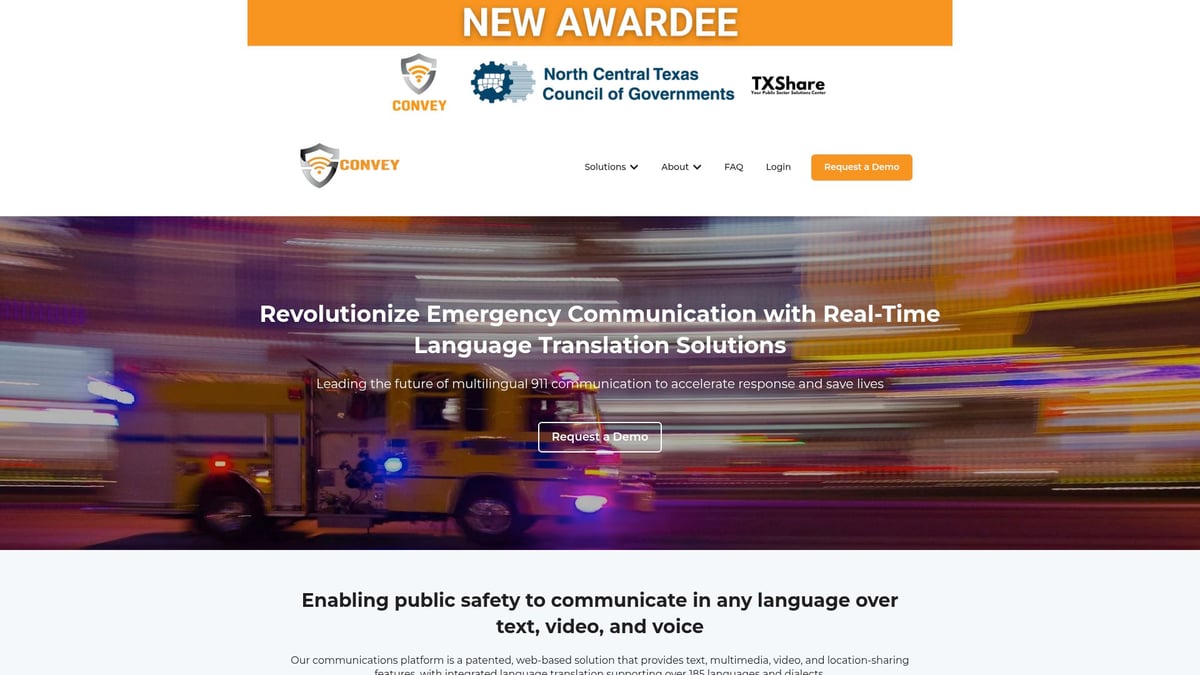
Their platform supports over 185 languages, delivering live interpretation in less than two seconds. Features include rapid language identification, text-to-911, hybrid AI and human interpreter access, and robust multilingual notifications.
With more than 50,000 minutes of live interpretation handled every month, Convey911 bridges the critical gap where non-English speakers might otherwise wait up to 10 minutes for help. Their mission is to ensure that everyone receives timely, accurate emergency assistance, regardless of language.
Integration with Business and Communication Platforms
Businesses worldwide now embed translation APIs to translate english to any language directly within their workflows. E-commerce platforms, CRMs, chatbots, and customer service tools offer instant multilingual support for users and clients.
Automated translation of user-generated content, reviews, and support tickets boosts global reach and customer satisfaction. For instance, online retailers track higher conversion rates when product information is available in multiple languages.
According to recent data, 56 percent of online shoppers consider language accessibility a deciding factor. Seamless integration of translation technology is now a competitive advantage for businesses seeking to expand internationally.
Human vs. AI Translation: Accuracy, Speed, and Use Cases
Choosing how to translate english to any language is a pivotal decision for organizations and individuals alike. Today, the landscape offers a spectrum between human expertise and AI-driven efficiency, each with distinct strengths and limitations.
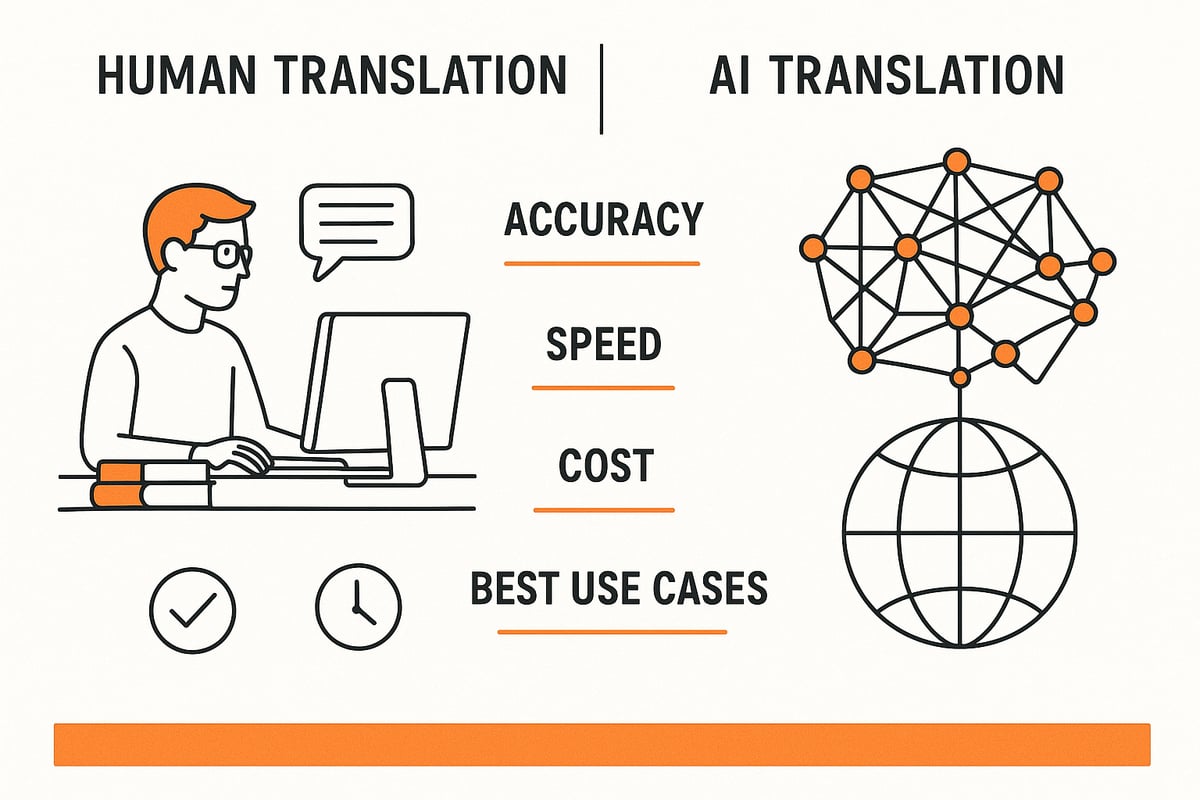
Comparing Human and AI Translation
Human translators bring deep cultural understanding and the ability to interpret nuance, emotion, and context. They excel when tasked to translate english to any language for legal, medical, creative, or sensitive materials. Human expertise is essential for idioms, humor, or content where a single misstep could have critical consequences.
AI translation, powered by neural networks and big data, shines in speed and scalability. For high-volume, repetitive, or low-risk content, AI can translate english to any language in seconds, making it ideal for technical manuals, e-commerce listings, or news aggregation. Major AI engines now deliver over 90 percent accuracy for common language pairs, though accuracy declines for rare or less-resourced languages.
| Feature | Human Translation | AI Translation |
|---|---|---|
| Accuracy | 98-100 percent (with review) | 90-97 percent (major languages) |
| Speed | 500-2,000 words/day | Instant (thousands of words/sec) |
| Cost | Higher | Lower (up to 60 percent less) |
| Best Use Cases | Legal, medical, creative | Technical, bulk content |
| Cultural Nuance | Excellent | Limited |
Use Cases and Workflow Integration
Deciding when to translate english to any language using humans or AI depends on the stakes and subject matter. For example, legal contracts, medical reports, and advertising campaigns demand human oversight. In contrast, technical documentation, FAQs, or user-generated reviews can often rely on AI with minimal risk.
A growing trend is hybrid translation, where AI produces a draft and human experts refine the output. This workflow is common in industries like media and entertainment. For instance, subtitles for streaming platforms are now typically AI-generated, then edited by linguists for cultural accuracy and flow. According to recent industry data, over 70 percent of organizations now blend AI and human translation for optimal results.
Speed and cost are decisive factors. AI can reduce translation costs by up to 60 percent and turnaround times by 80 percent. However, post-editing by humans remains vital to ensure quality, especially when you need to translate english to any language for mission-critical content.
For a deeper look at how AI and human interpreters work together—especially in high-stakes environments like emergency services—see Human and AI Interpreters in Translation.
The Future of Hybrid Translation
Post-editing, where human editors refine AI-generated translations, is rapidly becoming the industry standard. This approach leverages the strengths of both worlds, delivering accuracy, efficiency, and cultural relevance. As AI continues to advance, translators are shifting towards roles as editors, quality assurance reviewers, and cultural consultants.
Ultimately, to translate english to any language effectively in 2026, the best results come from a thoughtful combination of advanced technology and human insight. The right balance depends on your content type, audience, and goals.
Best Practices for Effective English to Any Language Translation
Translating content across languages requires more than just swapping words. To translate english to any language successfully, you need a holistic approach that considers cultural nuances, consistency, quality, and legal responsibilities. Let’s explore the essential best practices that ensure your translations are accurate, meaningful, and effective.
Ensuring Cultural Sensitivity and Contextual Accuracy
When you translate english to any language, cultural sensitivity is crucial. A literal translation often misses idioms, humor, or references that only make sense within a specific culture. For example, a marketing slogan that works in the US might confuse or even offend audiences elsewhere.
To avoid these pitfalls, research the target culture thoroughly. Adapt idioms and humor so they resonate locally. Engage native speakers to review your content for context and appropriateness. Remember, 40% of global marketing failures are linked to cultural insensitivity.
Key tips:
- Study local customs and social norms
- Adjust tone and references for the audience
- Use back-translation to catch subtle errors
Following Best Practices for Translation Projects can help you build a repeatable process for cultural review and adaptation.
Maintaining Consistency and Terminology
To translate english to any language effectively, maintaining consistency in terminology is essential, especially for technical or branded content. Inconsistent vocabulary can confuse users and damage your credibility.
Build and use translation glossaries and style guides. These resources help translators use the same terms for repeated concepts, which is especially important in fields like medicine or technology.
Recommended tools:
- Translation memory software (e.g., SDL Trados, MemoQ)
- Terminology databases for industry-specific terms
- Regularly updated style guides
Pharmaceutical companies, for instance, rely on strict terminology to ensure patient safety. By standardizing language, you reduce errors and strengthen your brand trust.
Quality Assurance and Continuous Improvement
Quality should never be an afterthought when you translate english to any language. A robust QA process includes automated checks, bilingual peer reviews, and user feedback.
Multi-stage review processes catch errors that automated tools might miss. Update your translations regularly to reflect new terminology or user suggestions. For software companies, this might mean iterating UI translations based on customer input.
Consider these QA steps:
- Automated spelling and grammar checks
- Peer review by native speakers
- Collecting and acting on user feedback
Continuous quality assurance can reduce error rates by 35%. With 79% of translators now using AI tools, combining automation with human oversight is more important than ever (79% of translators use AI tools).
Legal, Ethical, and Privacy Considerations
Every time you translate english to any language, you must comply with local and international laws. Regulations like GDPR and HIPAA protect user data and require secure translation workflows.
Ethical considerations include preventing bias in AI-driven translations and ensuring user consent. For confidential documents, use encryption and secure storage to protect sensitive information.
Best practices for compliance:
- Use anonymization for personal data
- Encrypt files during storage and transmission
- Limit access to sensitive content
A significant portion of organizations cite privacy as a top concern in translation projects. Staying up to date on legal requirements ensures your translations are not only effective but also safe and ethical.
Future Trends in Language Translation: What to Expect by 2026 and Beyond
The landscape of language translation is evolving rapidly, and the ability to translate english to any language is becoming more seamless each year. By 2026, translation technology is expected to be deeply embedded in how we communicate, work, and learn. As global interactions increase, the need for effective, accurate translation grows even more critical.
AI and Multimodal Translation
Artificial intelligence is transforming the way we translate english to any language. New neural networks can process not just text, but also speech, video, and even images. Multimodal translation means that users can translate conversations in real time, subtitles in videos, or even text found in photos.
This innovation supports smoother global collaboration. For example, video calls now feature instant, accurate subtitles in multiple languages. With these advances, the AI translation market is projected to reach $23.53 billion by 2032, reflecting the increasing demand for real-time multilingual communication.
Supporting Low-Resource and Endangered Languages
Efforts to translate english to any language now include expanding support for lesser-known languages. AI models are increasingly trained on low-resource and endangered languages, helping preserve cultural heritage and provide access to critical information.
However, accuracy can vary significantly depending on language and context. For an in-depth look at these challenges, see AI translation accuracy varies by language. These improvements ensure more inclusive communication, especially in education and healthcare.
Real-Time Translation in AR/VR and Wearables
The integration of translation technology into augmented reality, virtual reality, and wearable devices enables users to translate english to any language on the go. Imagine smart glasses that display real-time subtitles during a conversation, or AR apps that instantly translate street signs and menus abroad.
These advancements are not just futuristic—they are becoming practical tools for travelers, professionals, and emergency responders. By 2026, over 60% of global web content is projected to be automatically translatable, making information more accessible than ever.
Voice Assistants, Smart Devices, and Automation
Voice assistants and smart devices are now core tools for those who need to translate english to any language daily. Devices can listen, interpret, and respond instantly in the user's preferred language, bridging communication gaps at home, in business, or while traveling.
Automated translation is also improving in accuracy and speed, empowering users to interact with technology naturally and intuitively.
Human-AI Collaboration and Industry Impact
While AI makes translation faster, human expertise remains vital for nuance and cultural context. Translators are increasingly acting as editors and cultural consultants, refining AI output and ensuring sensitive materials are accurately localized.
This collaboration is reshaping industries. Businesses, educators, and healthcare providers can reach wider audiences, while public safety agencies rely on instant translation for rapid response. As the ability to translate english to any language improves, global communication becomes more inclusive, precise, and impactful.
As we've explored, breaking down language barriers is more critical than ever—especially when lives are on the line. Whether you're managing emergency communications or striving for seamless multilingual interactions, having the right tools makes all the difference. If you're ready to see firsthand how cutting edge language translation can empower your team and ensure no call for help goes unheard, I encourage you to Book a Demo. Discover how real time translation solutions can transform the way you connect, respond, and keep communities safe.