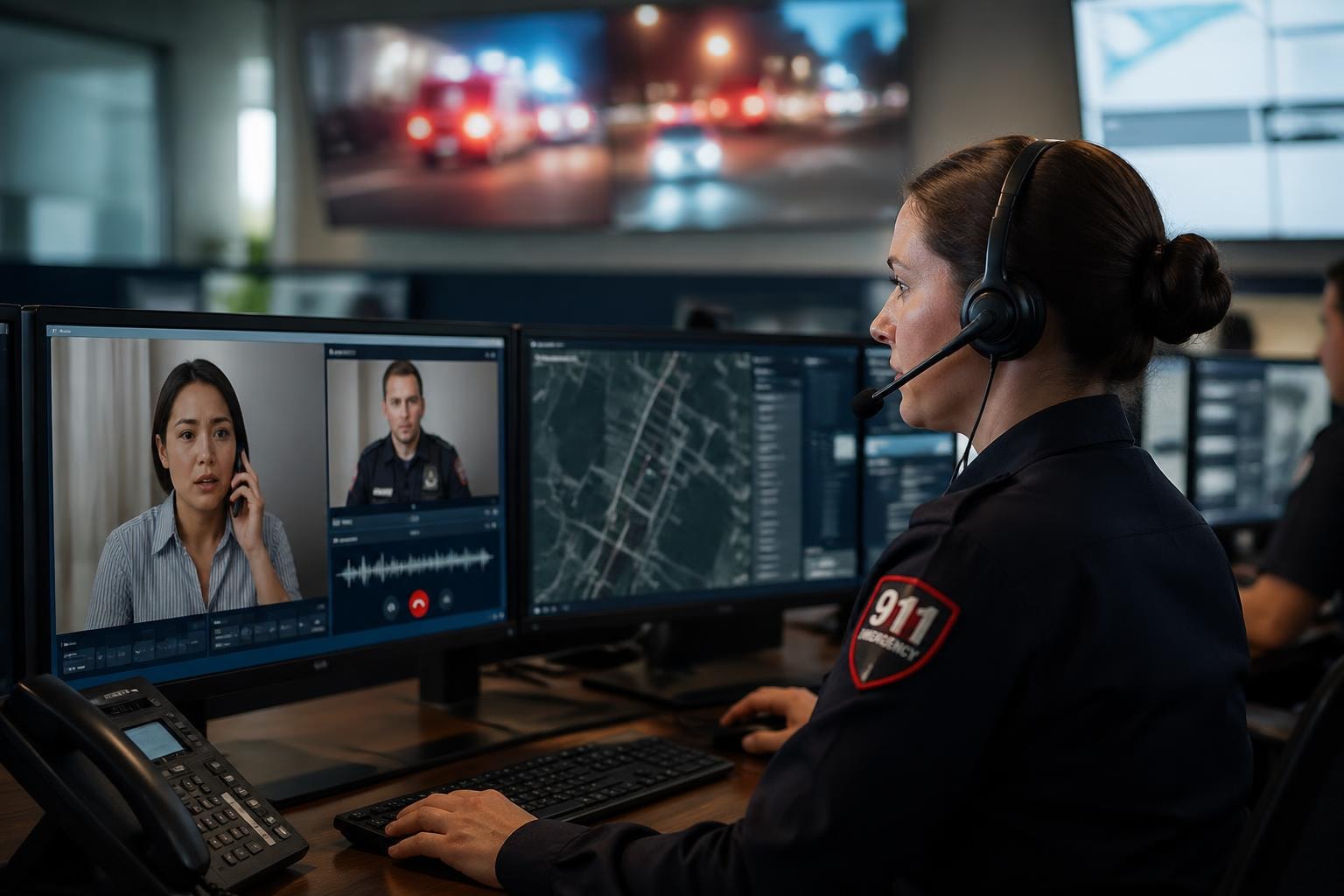

When seconds matter in emergency situations, language barriers cannot become life-threatening...
In emergency situations, every second counts. When language barriers exist between callers and responders, the speed at which information is translated becomes a critical factor that can determine outcomes. Translation speed encompasses not only how quickly words are converted from one language to another, but also the efficiency of the entire communication process from initial contact through response deployment. For public safety agencies and emergency communication centers, understanding the factors that influence translation speed is essential for delivering effective, timely assistance to diverse communities.
The Critical Role of Translation Speed in Emergency Response
Public safety agencies face unique challenges when providing services to multilingual populations. Unlike commercial translation scenarios where delays of minutes or hours may be acceptable, emergency situations demand near-instantaneous language conversion.
The importance of translation speed extends beyond mere convenience. When someone calls 911 experiencing a medical emergency, house fire, or violent crime, delays in understanding their situation can have life-threatening consequences. First responders require accurate information about the nature of the emergency, the location, potential hazards, and the number of people involved.
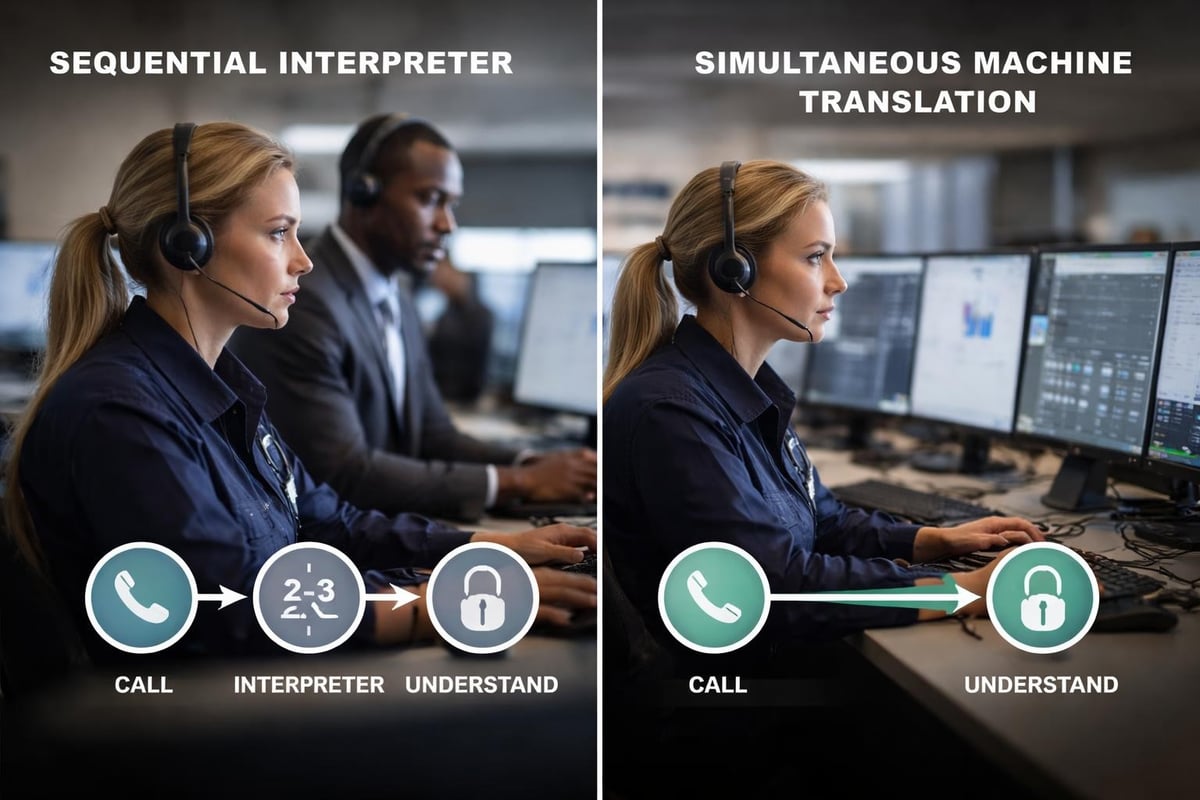
Traditional interpreter services, while valuable in many contexts, often introduce significant delays:
- Average connection time to a live interpreter: 45-90 seconds
- Additional time for three-way communication relay
- Potential for information loss during sequential interpretation
- Limited availability for rare languages during off-hours
These delays compound in emergency scenarios. A 90-second wait to connect with an interpreter, followed by back-and-forth relay communication, can easily extend a critical 911 call by several minutes.
Machine Translation Technology and Speed Considerations
Modern machine translation has revolutionized how quickly text can be converted between languages. Neural machine translation systems can process sentences in milliseconds, offering unprecedented translation speed for written communication. However, translation quality and inference speed involve important trade-offs that emergency communication providers must carefully consider.
Speed vs. Accuracy Trade-offs
The relationship between translation speed and accuracy presents a fundamental challenge. Google recently introduced features allowing users to choose between speed and accuracy in Google Translate, acknowledging that faster translations may sacrifice nuance for immediacy.
For emergency communications, this trade-off requires careful calibration:
| Priority Level | Speed Requirement | Accuracy Threshold | Use Case |
|---|---|---|---|
| Critical | <100ms | 95%+ | Location information, immediate danger |
| High | <500ms | 98%+ | Medical symptoms, suspect descriptions |
| Standard | <2 seconds | 99%+ | Background information, follow-up questions |
Understanding different translator types helps agencies select the right technology for their specific needs, balancing speed requirements with accuracy demands.
Real-Time Voice Translation Challenges
Voice translation introduces additional complexity beyond text conversion. The system must:
- Capture and process audio input
- Convert speech to text (speech recognition)
- Translate text between languages
- Convert translated text back to speech (text-to-speech)
- Deliver audio output with minimal latency
Each step adds processing time. While text translation software can operate extremely quickly, voice translation systems typically require 1-3 seconds for the complete cycle under optimal conditions.
Network latency, audio quality, background noise, and accent variations can further impact translation speed in voice communications. Emergency environments often feature challenging acoustic conditions that compound these issues.
Factors Influencing Translation Speed in Emergency Contexts
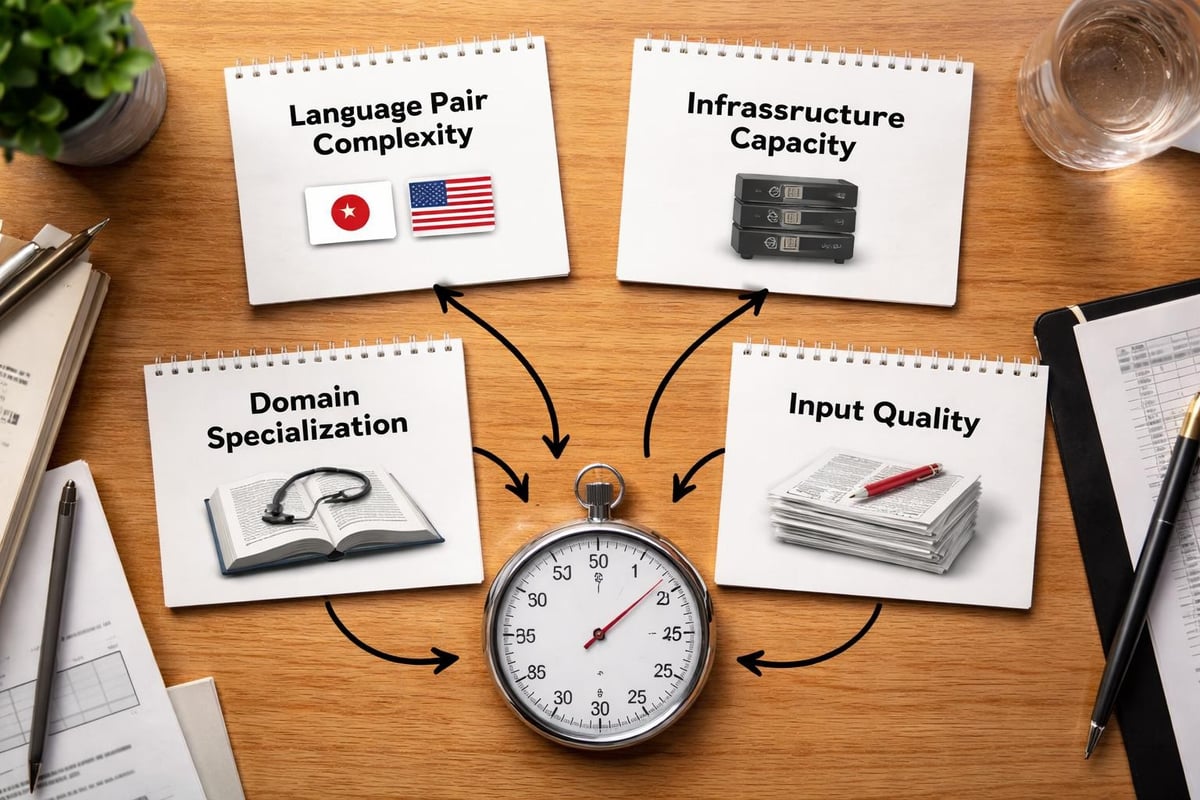
Multiple variables affect how quickly translations can be delivered in real-world emergency scenarios. Understanding these factors enables agencies to optimize their systems for maximum performance.
Language Pair Complexity
Not all language pairs translate at the same speed. Common language pairs with extensive training data (English-Spanish, English-French) typically process faster than rare language combinations. The linguistic distance between languages also matters:
- Similar language structures (Spanish-Portuguese): Faster processing
- Different writing systems (English-Arabic): Additional processing for script conversion
- Tonal languages (Mandarin, Vietnamese): More complex speech recognition
- Agglutinative languages (Finnish, Turkish): Longer words requiring more analysis
Agencies serving diverse communities must ensure their translation systems maintain acceptable translation speed across all relevant language pairs, not just the most common ones. Platforms supporting languages for the future must balance broad coverage with performance optimization.
Technical Infrastructure and Processing Power
The hardware and network infrastructure supporting translation systems directly impacts delivery speed. Cloud-based translation services depend on:
- Server processing capacity
- Network bandwidth and latency
- Geographic proximity of servers to end users
- Load balancing during high-demand periods
Edge computing solutions can reduce translation speed by processing data closer to the source, eliminating round-trip delays to distant servers. For emergency communication centers, hybrid approaches combining local processing for common tasks with cloud resources for complex translations often provide optimal performance.
Context and Domain Specialization
Generic translation systems designed for everyday conversation may struggle with emergency-specific terminology. Specialized systems trained on public safety vocabulary can deliver faster, more accurate translations because they:
- Recognize emergency-specific terms immediately
- Apply appropriate context to ambiguous words
- Prioritize critical information in translation output
- Reduce processing time by eliminating irrelevant interpretation options
A system familiar with terms like "chest pain," "assault," or "structure fire" processes these phrases more efficiently than a general-purpose translator encountering them for the first time. Understanding rules of translation specific to emergency contexts improves both speed and reliability.
Optimizing Translation Speed for Emergency Operations
Public safety agencies can implement specific strategies to maximize translation speed while maintaining the accuracy necessary for effective emergency response.
Pre-Translation and Template Systems
Many emergency calls follow predictable patterns. Developing translated templates for common questions and responses significantly accelerates communication:
- Pre-translated standard questions instantly available to dispatchers
- Quick-select response options in multiple languages
- Location verification scripts ready for immediate deployment
- Instruction sets for common emergencies (CPR, Heimlich, fire evacuation)
This approach combines the translation speed of pre-prepared content with the flexibility of real-time translation for unique information. Dispatchers can quickly ask standardized questions while the system translates specific answers from the caller.
Asynchronous and Multi-Modal Communication
Relying solely on sequential voice translation creates inherent delays. Emergency translation systems that leverage multiple communication modes simultaneously can maintain information flow:
- Voice conversation for immediate verbal exchange
- Simultaneous text display showing translated transcripts
- Visual aids and pictograms for universal understanding
- Video capabilities for visual context
Multi-modal approaches allow participants to process information through multiple channels, compensating for delays in any single mode. A caller might speak while simultaneously seeing translated text appear, providing redundancy and confirmation.
Intelligent Caching and Prediction
Advanced translation systems can improve apparent translation speed through predictive technologies:
- Caching frequently used phrases for instant retrieval
- Predictive text completion based on partial input
- Context-aware suggestions anticipating likely responses
- Learning from historical call patterns in specific service areas
These techniques reduce actual processing requirements by anticipating needs before complete input is received. A system recognizing the phrase "I need an ambu..." can begin preparing the translation for "ambulance" before the speaker finishes.
Measuring and Monitoring Translation Speed Performance
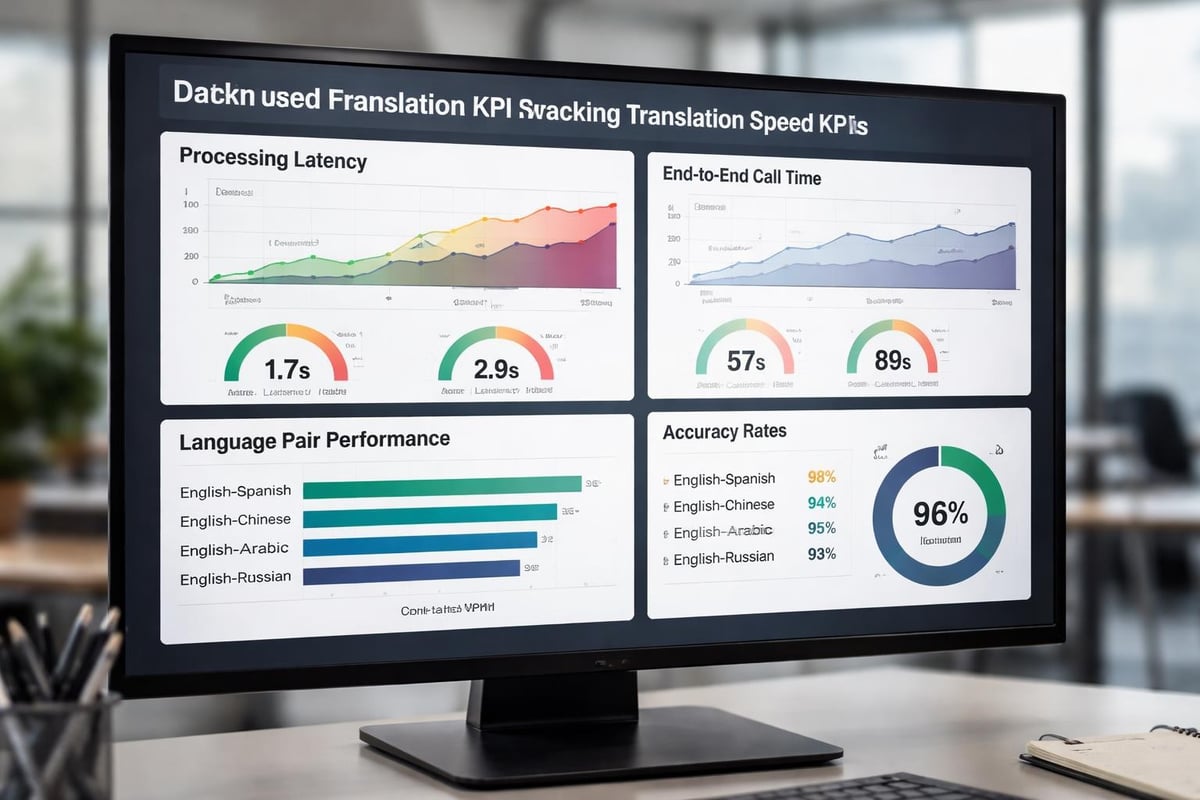
Systematic measurement provides the foundation for continuous improvement. Emergency communication centers should establish clear metrics for translation speed:
| Metric | Target | Measurement Method |
|---|---|---|
| Initial connection time | <5 seconds | Time from translation request to first output |
| Processing latency | <500ms | Time between input completion and translation delivery |
| End-to-end call duration | Minimize | Total call time compared to English-only baseline |
| Language availability | 99.9% uptime | System availability for all supported languages |
Regular monitoring reveals performance trends, identifies problematic language pairs, and highlights infrastructure limitations. Comparing these metrics against translation guidelines ensures systems meet professional standards.
Real-World Performance Testing
Laboratory testing provides baseline measurements, but real-world conditions often differ significantly. Public safety agencies should conduct regular testing under realistic conditions:
- Background noise simulation replicating actual emergency environments
- Accent variation testing with diverse speaker samples
- Network stress testing during high-call-volume periods
- Multi-party communication scenarios involving callers, dispatchers, and responders
Research on post-editing versus human translation demonstrates that translation speed varies considerably based on content complexity and translator familiarity with subject matter. Emergency contexts require testing with actual emergency scenarios to ensure realistic performance assessment.
Integration with Emergency Communication Infrastructure
Translation systems cannot operate in isolation. Their effectiveness depends on seamless integration with existing emergency communication infrastructure. Translation speed suffers when systems require manual switching, separate platforms, or duplicate data entry.
Modern integrated platforms should provide:
- Single-interface access to all communication modes
- Automatic language detection and translation activation
- Seamless handoff between dispatchers and field units
- Integration with CAD (Computer-Aided Dispatch) systems
- Synchronized translation across text, voice, and video channels
The concept of two-way translation becomes critical in emergency communications, where information must flow rapidly in both directions. Dispatchers need to ask questions and provide instructions while callers describe situations and request specific assistance.
Mobile Responder Access
Translation speed requirements extend beyond the communication center to first responders in the field. Officers, firefighters, and paramedics need immediate translation capabilities when they arrive on scene. Mobile applications must deliver comparable translation speed despite:
- Variable cellular network conditions
- Limited processing power on mobile devices
- Challenging environmental conditions
- Need for offline functionality in coverage gaps
Hybrid approaches combining on-device translation for common phrases with cloud connectivity for complex translations help maintain performance across diverse field conditions. Understanding how applications to translate languages function in real-world emergency scenarios informs better deployment strategies.
Future Developments in Emergency Translation Speed
Emerging technologies promise continued improvements in translation speed and capabilities. Artificial intelligence advances, particularly in neural networks and natural language processing, drive ongoing enhancements in both speed and accuracy.
Anticipated developments include:
- Real-time dialect and accent adaptation
- Emotion and urgency detection in voice patterns
- Predictive translation based on emergency type
- Quantum computing applications for complex language pairs
- Enhanced offline capabilities for network-independent operation
Edge AI processing will likely play an increasing role, enabling translation speed improvements by performing more computation locally rather than depending on round-trip cloud communications. This approach reduces latency while maintaining the accuracy benefits of sophisticated neural models.
The evolution of language translation models continues to push the boundaries of what's possible in real-time communication across language barriers. Public safety agencies should stay informed about these developments to plan future technology investments strategically.
Translation speed represents a critical success factor for emergency communication systems serving multilingual populations. The difference between delayed and immediate understanding can directly impact response effectiveness and outcomes. By optimizing technology, training personnel, and continuously measuring performance, public safety agencies can ensure language barriers never delay life-saving assistance. Convey911 provides specialized emergency communication and translation software designed specifically for public safety, delivering real-time translation across text, voice, and video in over 185 languages, helping agencies communicate effectively when every second counts.